
Four layers of agent-ready infrastructure
AI agents change infrastructure demand. Their requests are continuous, multi-step, and often unpredictable, so compute, networking, and storage must scale across public cloud, data center, and edge environments without creating new bottlenecks.
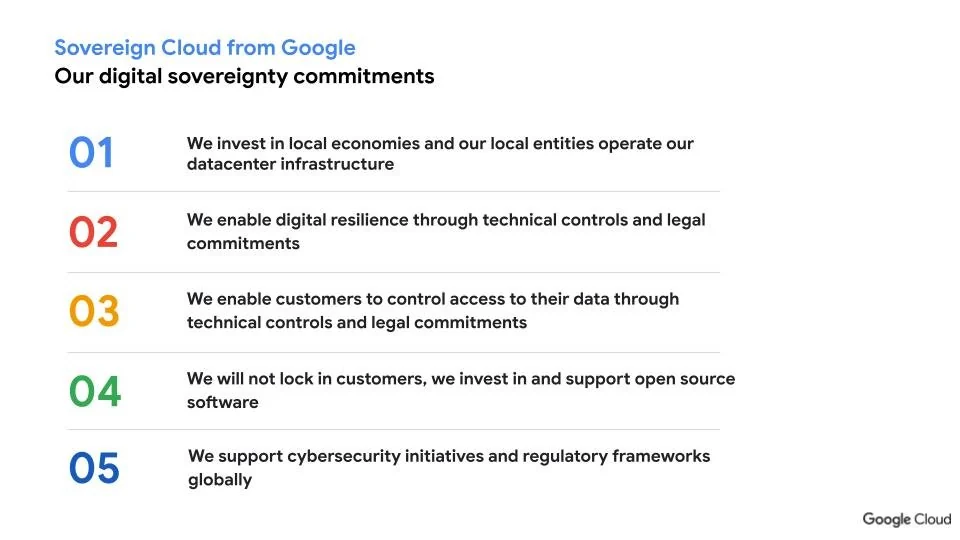
A practical foundation combines fluid compute, secure cross-cloud connectivity, a unified data layer, and digital sovereignty. Machine identity, traffic observability, and tool-access boundaries belong in the initial architecture rather than being added after deployment.
Design and operating model
In a cross-cloud architecture, basic connectivity is not enough. The engineering team needs to trace where every agent request starts, which identity it uses, what data it needs, which tools it calls, and where the outcome is recorded. The chain becomes governable only when access policy and observability carry the same meaning across environments.
Deterministic workloads should also be separated from agentic demand. Finance and operational systems usually have more predictable capacity patterns, while agents can suddenly create many searches, tool calls, and model requests. Consumption limits, queues, priorities, and isolated execution environments keep one failure from spreading across the platform.
Daily operations should combine traditional infrastructure indicators with end-to-end latency, tool error rate, data consumption, cost per task, and human-intervention rate. A shared view allows infrastructure and AI teams to investigate the same problem using a common language.
When an agent request crosses environments
Imagine a customer-service agent reading order history in a data center, checking inventory in one cloud, and generating a response in another. Network connectivity is only the beginning: user permissions must survive each step, sensitive information should not move unnecessarily, and a broken connection must not cause a financial action to run twice. Define where each step runs and who records it before selecting services.
In a real pilot, measure more than model response time. Include cross-environment latency, data-transfer cost, tool-call count, and behavior when a connection fails. If data repeatedly moves between clouds, placing computation nearer the data may help more than adding processing capacity.
Start with one real workflow
Start by mapping agent flows, data sources, and trust boundaries. Validate capacity, access policy, and quality signals in a real pilot so the platform behaves predictably and remains auditable before it expands.
This Liyan Knowledge article is an editorial synthesis based on the original source.View original source